He Built This City — Literally.

Founding Tier
This post lives in the Founding tier of Creativity Meets Capital — a space for proximity to process and in-progress thinking. It’s offered to readers who choose to support the work beyond the public archive.
What does it mean to spend twenty-two years building something no one asked you to build?
In 2004, Queens-born artist Joe Macken began constructing a scale model of New York City in his basement. Not as a commission. Not as a grant-funded proposal. Not as an institutional residency.
Just because he said he would.
As a first grader visiting the 1964–65 World’s Fair, he rode the little train around the Panorama of the City of New York — now housed at the Queens Museum — and told a classmate, “I’m going to build one of these myself one day.”
Forty years later, he started with one building.
Then another.
Then another.
Today, that promise spans fifty feet.
The Work
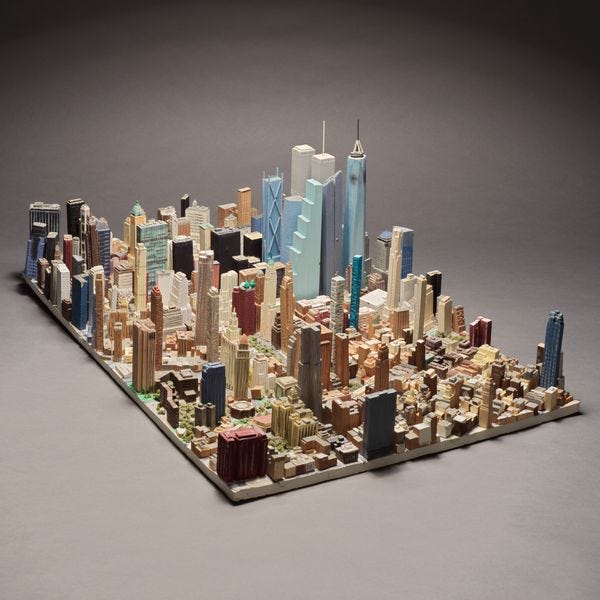
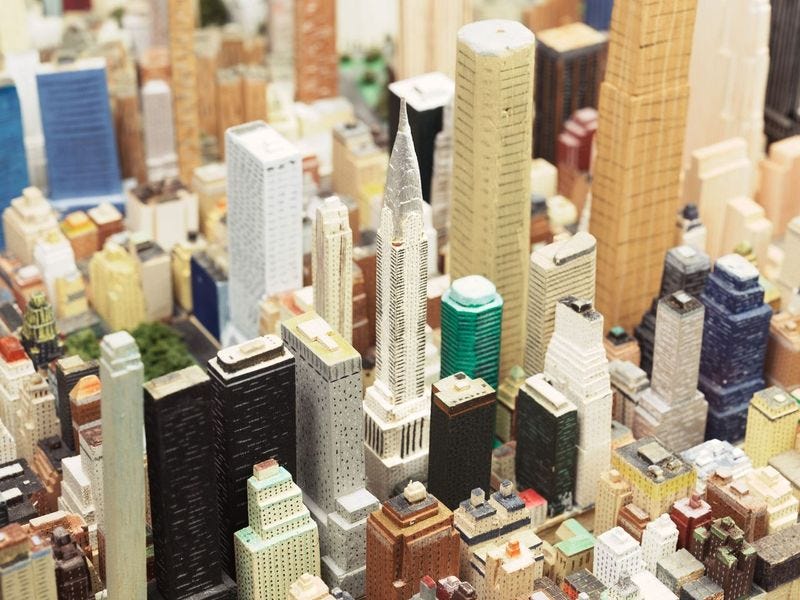
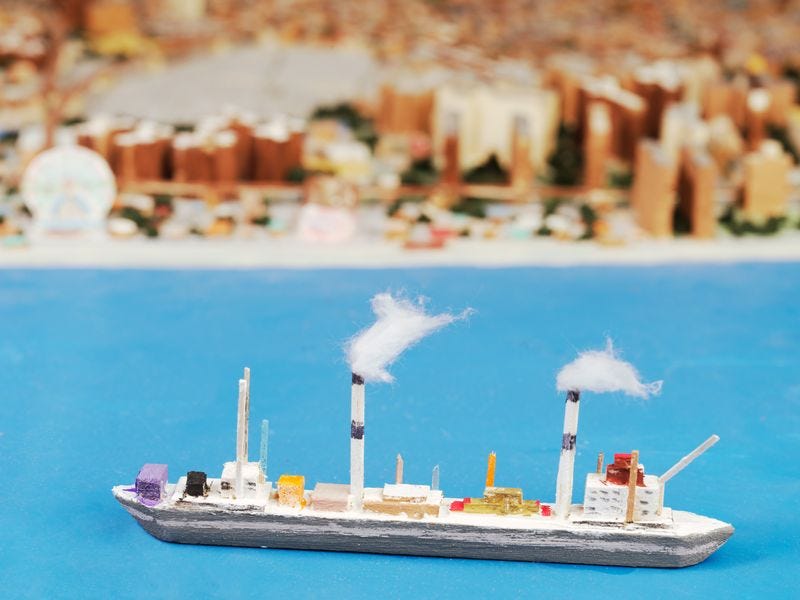
He Built This City is a hand-crafted architectural model of all five boroughs of New York City. Built from balsa wood, cardboard, styrofoam, craft paint, and Elmer’s glue, the model is composed of more than 300 individual sections and captures everything from skyline icons to outer-borough residential blocks.
Rather than thinking this is a stylized interpretation, Macken created total inclusion — nearly every building represented.
The Empire State Building and a row house in Queens receive the same attention. The skyline and the schoolyard exist on equal footing.
Meticulous.
Obsessive.
Profoundly personal.
And it is still expanding.
Where It Lives Now
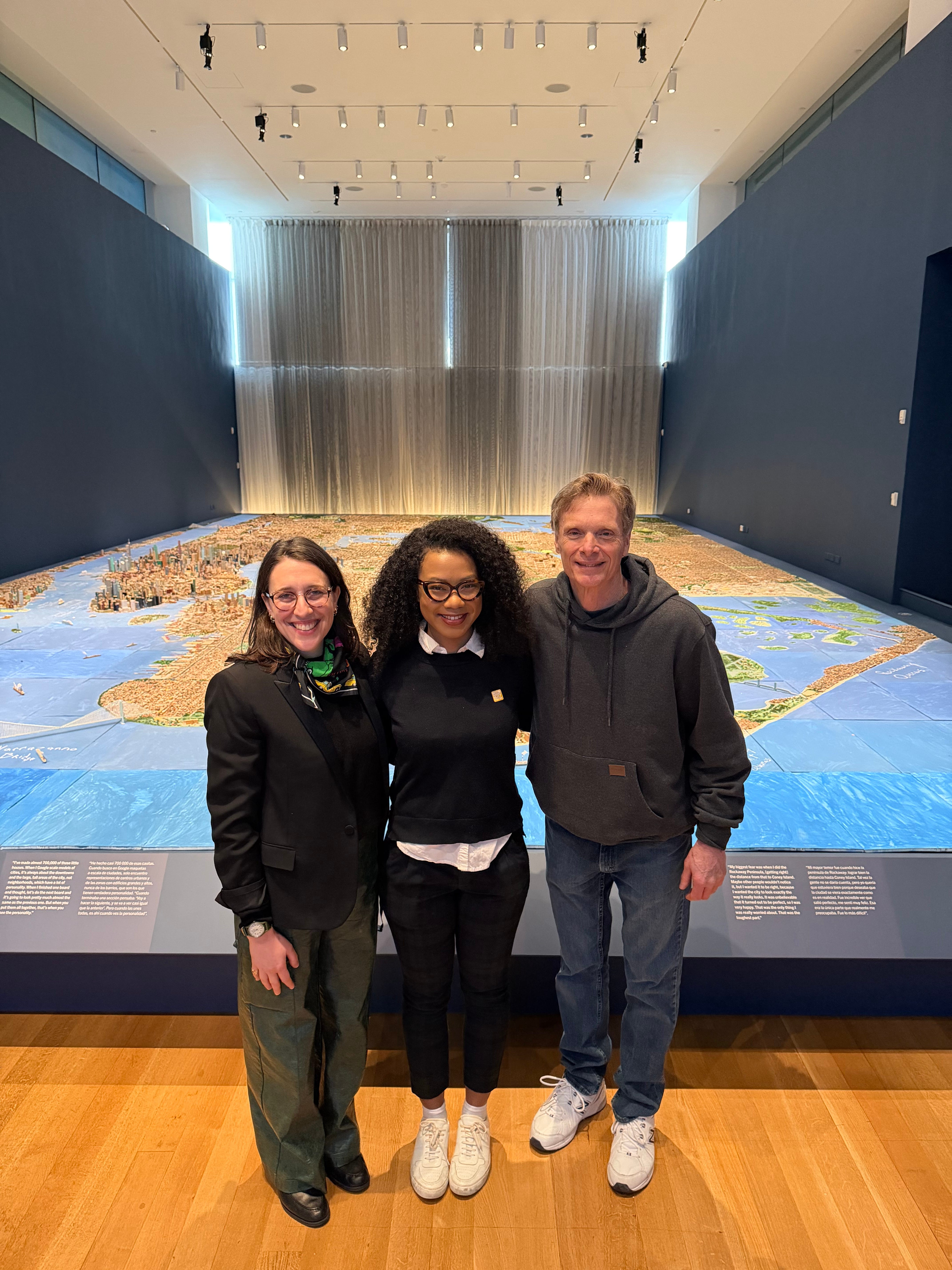
For the first time, Macken’s model is being presented publicly in New York City at the Museum of the City of New York in the exhibition He Built This City.
The museum, dedicated to the people, places, and ideas that shape New York, offers the project something it has never had before: institutional framing.
The basement becomes gallery.
The hobby becomes exhibition.
The solitary act becomes collective experience.
Why This Matters
We often talk about scale in the context of growth metrics, valuations, square footage, market reach.
But this is a different kind of scale.
This is time scaled.
Twenty-two years without a commercial guarantee.
Without a collector waiting.
Without a promised audience.
Just repetition.
Precision.
Belief.
Before you read the full interviews below—with Joe Macken and with Chief Curator and Deputy Director Elisabeth Sherman—I want you to sit with that.
What are you building that no one sees yet?
What would happen if you committed to it for twenty years?
This is the story of a man who did.
Conversation with Joe Macken
Artist Perspective — Museum of the City of New York
This interview has been lightly edited for clarity and length.
Nina Orm:
This model represents more than two decades of sustained work. What initially compelled you to begin building in 2004, and what has kept you returning to it over time? I know I’ve read about how you were inspired by the World’s Fair—could you elaborate on that? And what keeps you motivated for 22 years to work on this?
Joe Macken:
Yeah, I went to the World’s Fair when I was in first grade, and I saw the model there—the Panorama. I was inspired right then and there. I even turned to my classmate who was sitting next to me on the little train that went around it and said, “I’m gonna build one of these myself one day.”
It took me a while. I was in my forties when I finally started my first building. I saw a documentary on TV about New York City, and I thought about the Panorama from when I was a kid. I said, “You know what? I have this wall space—let me start carving. Let’s build a building.”
I built Rockefeller Center—the RCA building—and the next day I built another, and then another, and another. I was enjoying it so much that I just kept going. And 22 years later, without stopping, this is what happened.
Nina Orm:
That’s incredible. The scale is extraordinary—both physically and temporally. How did you think about commitment when undertaking a project with no clear endpoint?
Joe Macken:
It wasn’t really like I had a beginning point or an endpoint. I was just doing it for fun. I didn’t know where it was going to take me. I wasn’t even looking at that. I just loved doing it so much. It was the sheer fun of doing it.
For the love of the game. That’s the only way to say it.
Most people do it because they want to complete something. This is only halfway done. It’s going to be 90 feet long and 50 feet wide in 10 years. I’m doing Westchester County, parts of New Jersey, Long Island, and Connecticut.
“For the love of the game.” — Joe Macken
Nina Orm:
Your materials are modest—balsa wood, cardboard, glue —yet the ambition is monumental. How do you think about material choice in relation to imagination and access?
Joe Macken:
I just wanted to keep it simple. That’s the way I am. I use Elmer’s glue— kindergarten stuff. Craft paint. Styrofoam. Balsa wood. Whatever’s easiest.
Even though it’s simple, it still looks like it was professionally made with professional materials. I wanted to do it my way — the way I like it.
Nina Orm:
With balsa wood being so delicate—did you ever worry about dents or damage, especially transporting it to the museum?
Joe Macken:
Many times. But I knew that going in. There are some dents here and there. But you know what? New York isn’t perfect either. New York has dents too.
If something’s really broken, I fix it. But most dents you can’t even notice. So I don’t worry about it.
“New York isn’t perfect either. New York has dents too.” — Joe Macken
Nina Orm:
When capturing New York’s skyline and neighborhoods, how did you decide what to include or leave out?
Joe Macken:
I tried my best to include every single building. With almost a million buildings, it’s easy to miss one. But my whole goal was to make sure I got every one.
I don’t really have architectural skills. This was just a hobby. But I looked at every single building and made sure I included it.
Nina Orm:
Were there personal landmarks you made sure to include? A favorite pizza spot?
Joe Macken:
Oh yeah. The iconic buildings—Empire State, Chrysler—I wanted those perfect. But when it came to my neighborhood, I made sure my block was perfect. The park across the street. The school. The outer boroughs are where you can miss things because there are so many houses. I wanted to make sure I got all of that.
Nina Orm:
Where does memory end and interpretation begin in your rendering of the city?
Joe Macken:
I’m from the city, so I know a lot about it. I went off memory for many neighborhoods. You don’t realize how many houses are on a block until you research it.
Queens was the easiest—I’m a Queens guy. Brooklyn was easy too. The Bronx and Staten Island were trickier. But it all worked out the way I liked it.
Nina Orm:
Seeing this work enter the Museum of the City of New York—how does institutional presentation change your relationship to it?
Joe Macken:
This is a whole new thing. I built it simply, working in my basement. I never thought it would end up in a museum. That was probably one of the last things I expected.
But it fits perfectly here. It works in this room. People are loving it. I guess it’ll fit anywhere.
“I tried my best to include every single building.” — Joe Macken
Nina Orm:
Final question — best slice? Best chopped cheese? Best bagel?
Joe Macken:
Favorite pizza — Sal’s Pizza on Elliott Avenue in Middle Village. I don’t know if it’s still there.
Pizza bagels — Bowers Bakery on Juniper Valley Road in Middle Village.
Chopped cheese — same place across the street from Bowers. I can’t remember the name, but definitely there.
I’m a pizza guy. I’ve gotta find out if Sal’s is still there.
Nina Orm:
Thank you so much for your time and congratulations on having your work presented here.
Joe Macken:
Thank you so much. I really appreciate it. Nice meeting you.
Conversation with Elisabeth Sherman
Chief Curator and Deputy Director — Museum of the City of New York
This interview has been lightly edited for clarity and length.
Nina Orm:
From a curatorial perspective, what made He Built the City resonate as a project that belonged to the Museum of the City of New York at this moment?
Elisabeth Sherman:
Subject matter-wise, it’s very clear why it belongs here at the Museum of the City of New York. It is a model of the five boroughs of New York, and we are dedicated to the people, places, and ideas that make this city great. And Joe’s project is great.
It is a project of passion and persistence—as you said—over 20 years looking at the model. The timing was fortuitous. I think any time would have been right for us to show the model. He had just completed the five boroughs and was ready for this opportunity, and we were ready to welcome him with open arms.
“There are incredible artists for whom time is one of their mediums — and the market can have a hard time with that.” — Elisabeth Sherman
Nina Orm:
Joe’s work reflects extraordinary patience and devotion. How should museums approach work shaped by long-term solitary commitment rather than traditional studio or market pathways?
Elisabeth Sherman:
There’s actually a great tradition of artists whose work is created over a long-term dedicated commitment. I was cleaning out some books this weekend and came across one of my favorite exhibition catalogs of On Kawara and thinking about how, while his work exists in individual paintings, it really is a life’s work of daily practice.
There are so many incredible artists for whom time is one of their mediums —and the market can have a hard time with that.
As a curator, I love celebrating projects that, because of their scale, duration, or materiality, don’t fit easily into the gallery system.
Nina Orm:
The model captures both iconic landmarks and everyday neighborhoods. How does this balance align with the museum’s mission to tell layered, inclusive stories about New York?
Elisabeth Sherman:
It aligns perfectly. We want to tell the stories of our heroes, our villains, the people we know—and the people we don’t know.
The people working behind the scenes to make and change the city. The people who would otherwise be anonymous but who really create the vibrant culture that makes living in New York unlike anywhere else in the world.
This is central to our mission. Joe’s model is a perfect representation of that.
Nina Orm:
What were the primary curatorial considerations in presenting a fifty-foot architectural model logistically and interpretively to ensure audiences grasp both its scale and intimacy?
Elisabeth Sherman:
I love that question. The number one curatorial logistical question was: Can it fit?
That was what we had to answer first. Working closely with our head of exhibition production, Todd Ludlum, we figured out that it just fit.
Then we thought about orientation—it’s facing north within our building, so the directions are true.
Especially in a solo artist project like this, I think the institution and the curatorial voice should often take a backseat.
What I wanted to foreground was Joe as the author—even though he’s the author of something we all collectively own, this city. This is his model, his version of the city.
All of the texts throughout the exhibition are direct quotes from Joe. I wanted visitors to feel like they could speak to him, understand his motivations, his passions, his persistence—not necessarily the curatorial voice.
“In a solo artist project like this, the institution and the curatorial voice should often take a backseat.” — Elisabeth Sherman
Nina Orm:
Looking ahead, how do you see institutions continuing to support and contextualize artists whose practices unfold over decades rather than cycles?
Elisabeth Sherman:
That’s the work we do.
Here at MCNY, we deal with over 400 years of New York City history. Duration is something we’re equipped to handle. Historical context and socio-political context are what make our exhibitions unique.
Putting artists who work outside the box into a greater context is exactly the kind of work we’re looking to do.
“You can set your mind to something and accomplish it.” — Elisabeth Sherman
Nina Orm:
When visitors leave this exhibition, what do you hope they carry with them about the city, about making, or about time itself?
Elisabeth Sherman:
I hope they carry the empowered feeling of: I can do what I set my mind to.
One step in front of another can lead to great things. You don’t have to come from an extraordinary position or have extraordinary innate abilities. You can set your mind to something and accomplish it.
About the city—I hope it reminds people of their love for this place. Or makes them fall in love with it for the first time.
And I hope it makes them want to explore the vastness and complexity of this wonderful place—and step outside their established pathways to discover something new.
The New York Rapid-Fire
Best hot dog?
Any old dirty water dog from the closest stand on the corner. That’s how a New York hot dog should taste.
Best chopped cheese?
Your local bodega. They make it the way you’re used to and the way you like it.
Bagel with lox?
There’s nothing like a paper-thin Russ & Daughters slice of lox.
After speaking with both Joe Macken and Elisabeth Sherman, what stays with me is not just the scale of the model, but the scale of commitment behind it. One man building, quietly, for twenty-two years. One institution recognizing that time itself can be a medium. Together, their conversations reveal something essential about creative work: it does not need to begin with permission to end in permanence. Sometimes the most enduring cultural contributions are born not from strategy, but from sustained devotion. In a city obsessed with acceleration, He Built This City reminds us that there is still power in moving slowly, in building carefully, and in trusting that what is made with patience will eventually find its place.