The Ledger — May 2026
A monthly record of culture, capital, and construction—what happened, what it means, and what we’re building next.

The Month in Culture
April 1–May 1, 2026
If you missed the room, here’s what mattered:
Art Market & Institutions
The spring art market conversation turned toward quality, stability, and fresh-to-market works. Bank of America’s Spring 2026 update noted renewed bidder energy around major single-owner collections and a stronger second half of 2025 heading into 2026—suggesting that collectors are still buying, but with more discipline.
Sotheby’s announced what it described as London’s most valuable auction ever, with the Lewis family collection estimated above £150 million and anchored by works by Klimt, Schiele, Bacon, Modigliani, Freud, and Matisse. Translation: blue-chip, museum-quality material is still where confidence concentrates.
The Studio Museum in Harlem announced its Spring/Summer 2026 season beginning May 1 at its 144 West 125th Street location, continuing momentum around one of the most important Black cultural institutions in the country.
Lower-priced works and emerging artists remain important entry points for new collectors. Bank of America’s U.S. art market analysis notes that lower-priced works and emerging artists help expand the market “from the bottom-up,” while the number of artists represented at U.S. auctions has widened over the past decade.
Film & Media
Sundance 2026 acquisitions continued to show that independent film distribution is becoming more strategic than splashy. IndieWire reported that only about a dozen of the 90-plus Sundance premieres arrived at the festival with distribution already in place, making post-festival deals an important signal of buyer appetite.
Los Angeles production showed modest signs of recovery in early 2026. Variety reported that L.A. production rose in Q1 as expanded California tax incentives began taking effect, suggesting the industry is still fragile but no longer entirely frozen.
Production economics remain a central pressure point in Hollywood. Variety’s 2026 Legal Impact Report noted rising production costs as one of the industry’s defining challenges, reinforcing why studios and producers are being more selective about what gets financed.
Capital & Ownership
Creator monetization is maturing beyond simple sponsorships. The 2026 Creator Signals Report, released April 14, focused on financial stability, lifestyle shifts, and content evolution as the creator economy continues to scale.
Creator businesses are increasingly judged by infrastructure, not just reach. A 2026 creator economy report highlighted brand deals, platform revenue shares, subscriptions, tipping, courses, and merch as monetization models—evidence that creators are being pushed toward diversified revenue architecture.
Brand partnerships are shifting toward longer-term relationships. ThoughtLeaders’ April 2026 trend report argued that the creator economy now rewards long-term partnerships, multi-format campaigns, and performance accountability over one-off sponsorships.
Policy & Power
Federal cultural funding remained under pressure. On April 3, Americans for the Arts Action Fund reported that the administration’s FY27 budget proposal again recommended severe cuts to cultural and educational funding.
The Los Angeles Times reported on April 17 that the proposed 2027 budget aimed to shutter the NEA, NEH, and IMLS, providing only enough funding to wind down operations—an enormous signal for cultural institutions dependent on public infrastructure.
AI art continued to force unresolved questions around authorship and ownership. Smithsonian Magazine reported April 24 that the world’s first museum dedicated to AI art is opening in Los Angeles while the art world continues debating ethics, sustainability, and copyright.
Cultural Signals
Quiet luxury still has cultural stamina. The Times published an April 1 guide to quiet luxury brands, signaling that understated wealth aesthetics remain commercially relevant even as fashion begins flirting again with expressive accessories and maximalism.
The creator economy is becoming more professionalized. April 2026 creator economy coverage points toward a market where brand investment is more structural, creators need multiple revenue streams, and attention alone is no longer enough.
Throughline: Culture is still moving but capital is becoming more selective. The winners are the ones with infrastructure, ownership, and strategic positioning.
Creativity Meets Capital engages selectively with brands, media, and institutions aligned with its core principles of cultural integrity, intellectual rigor, and long-term thinking.
Partnerships may include editorial collaborations, speaking engagements, strategic advisory, and curated programming.
All inquiries are reviewed with care.
Nina’s Desk
This month, I kept returning to one idea:
Creatives don’t have an income problem.
They have a leverage problem.
I’m watching incredibly talented people hit ceilings; not because they lack demand, but because they’re still operating in a transactional mindset.
Flat fees.
One-off deals.
Short-term thinking.
Meanwhile, the people building real wealth in the creative economy are doing something different:
They are structuring.
They are thinking in:
ownership
equity
distribution
systems
Not just output.
There’s a difference between being paid and being positioned.
And most creatives have never been taught how to make that shift.
If you’re interested in collaborating with Nina or Creativity Meets Capital—whether through editorial work, speaking engagements, or strategic partnerships—you’re welcome to share more details below.
Each inquiry is considered thoughtfully and in alignment with the long-term vision of the platform.
What We’re Building
A few things unfolding behind the scenes:
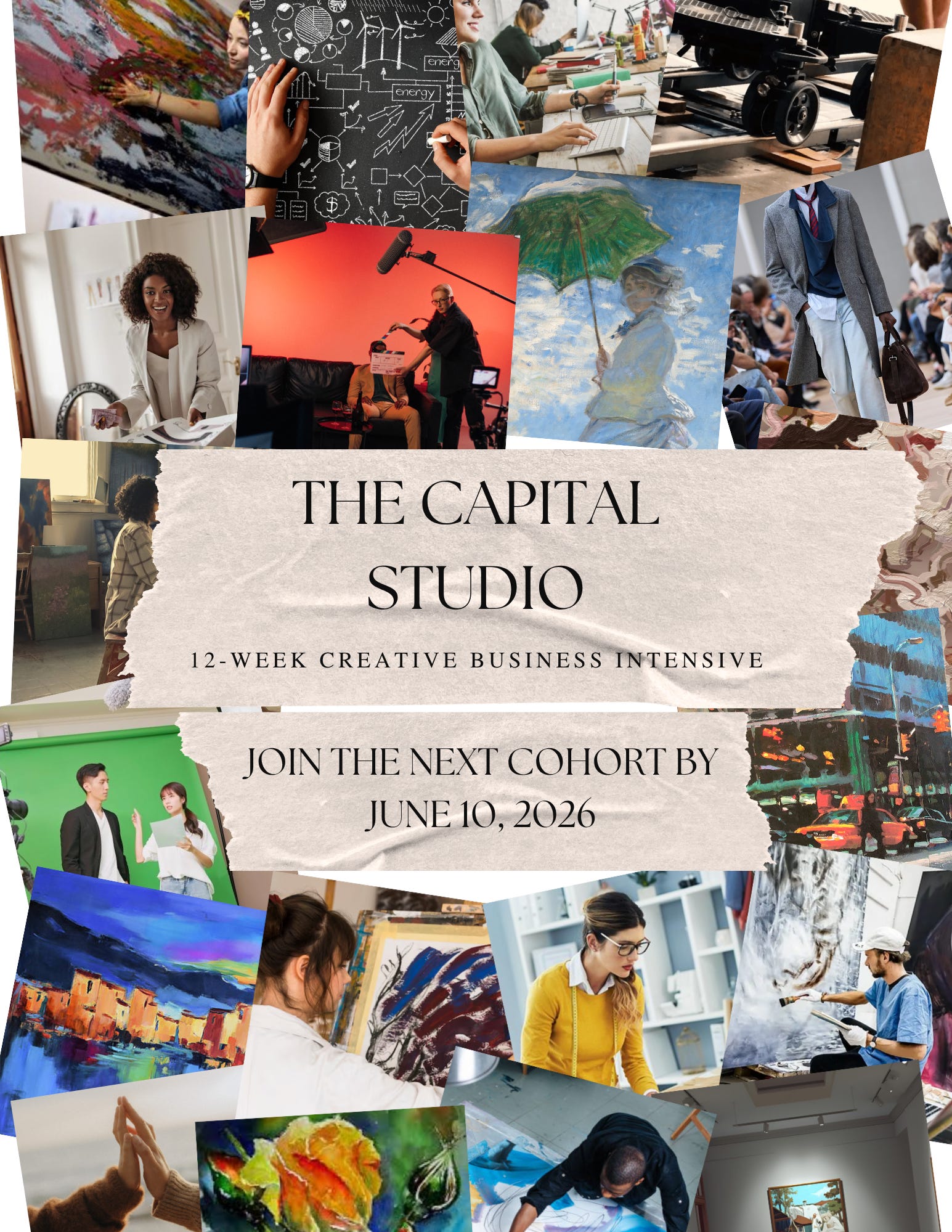
The Capital Studio
→ A new arm of Creativity Meets Capital focused on building and supporting creative businesses with real infrastructure—strategy, positioning, and capital design
→ Designed for founders ready to move beyond content and into ownership
May Patron Office Hours
Creative Capital 101: How Money Moves in the Creative Economy
→ Breaking down grants, brand deals, retainers, and IP
→ Live session + Q&ACreative Business Diagnostic
A 75-minute deep dive + 12-week strategic plan
→ For creatives ready to move from idea → infrastructureThe Legacy Study (Q2)
A quarterly forum on wealth, power, and inheritance
→ Next session themes will focus on reframing how we think about moneyAdvisory (Limited Capacity)
→ Foundation / Growth / Principal tiers
→ For founders building at the intersection of culture + capitalSome founders don’t need more information—they need a strategic partner.
Through Creativity Meets Capital Advisory, I work with creatives and founders over time to clarify direction, sharpen positioning, and support high-level decision-making.
Whether you’re laying the groundwork, scaling with intention, or navigating leadership-level choices, there’s an advisory pathway designed to meet you where you are.
Everything you’re seeing is intentional.
We are building infrastructure for a new creative class.
Community Signals
A few things you all are doing that I’m paying attention to:
One of you closed your first gallery placement after attending a salon series—this is exactly what happens when proximity meets preparation
Multiple subscribers have shifted from one-off brand deals into retainer-based partnerships (this is leverage in real time)
The questions coming into Office Hours are getting sharper—less “how do I start” and more “how do I scale”
These signals tell me the room is evolving.
Founding Members — Private Briefing
(For those building with proximity, not just access.)