Four Weeks Into The Capital Studio: What Teaching Has Taught Me About Building Creative Businesses

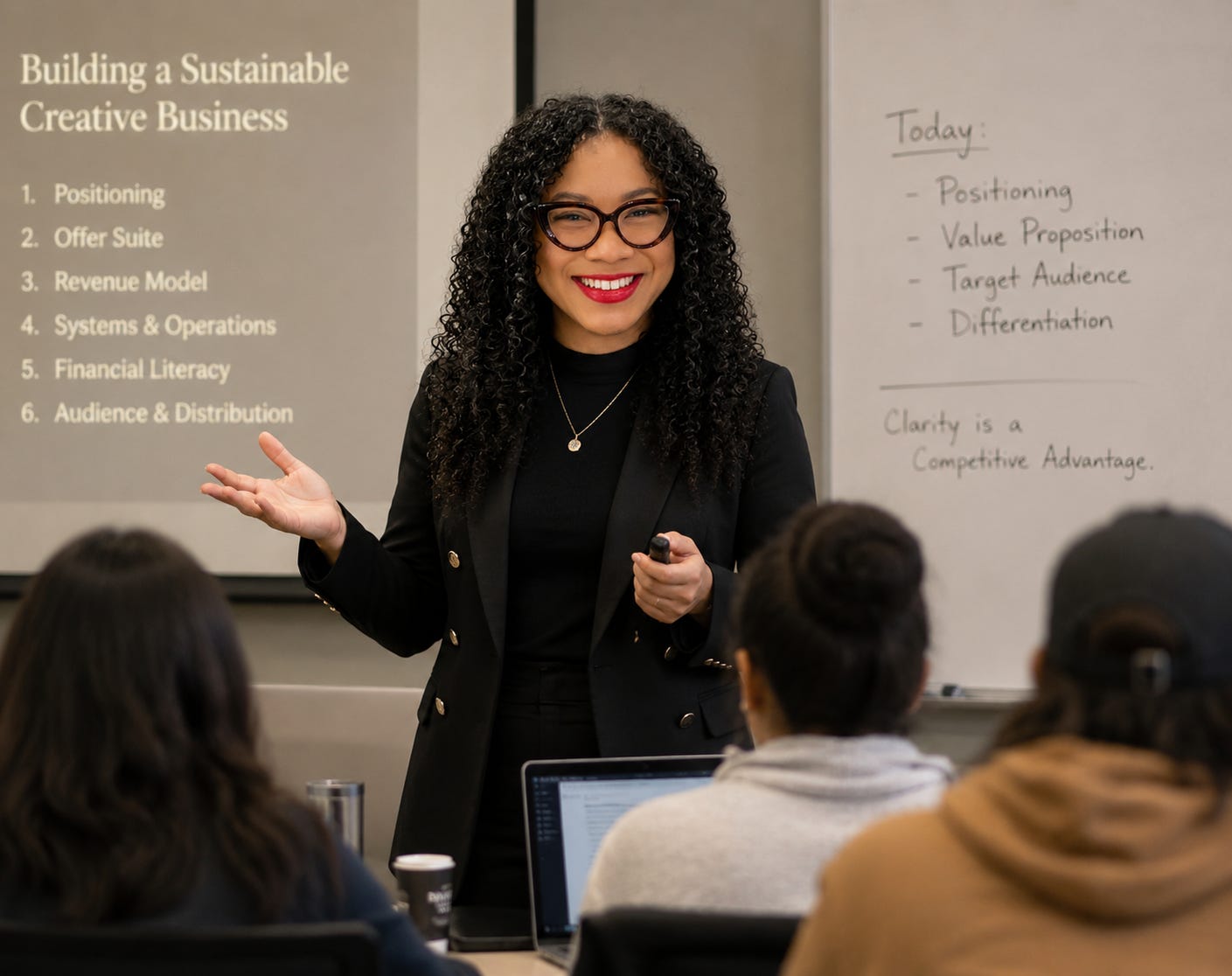
When I launched The Capital Studio on June 10, I expected to spend twelve weeks teaching business.
What I didn’t expect was how much the students would end up teaching me.
We’re now a little over one-third of the way through the inaugural cohort, and I’ve been reflecting on what has surprised me—not just about entrepreneurship, but about people.
For those who are new here, The Capital Studio is a twelve-week live business seminar designed specifically for creative founders. Every week, we spend three hours together dissecting one of the fundamental building blocks of a sustainable business. Positioning. Pricing. Financial literacy. Marketing. Operations. Strategy. Systems.
Every lecture ends with mandatory assignments.
Not busy work.
Actual business deliverables.
Students write positioning statements. Build customer profiles. Develop financial frameworks. Map revenue models. Everything is submitted, reviewed, graded, and returned with detailed feedback.
In many ways, this program is the culmination of years of my own education—studying political science, history, finance, entrepreneurship—and years of building businesses, making mistakes, and asking questions I wish someone had answered for me earlier.
This is also proof of something I have believed for a long time: creative minds are absolutely capable of building extraordinary businesses. Most simply have never been taught how.
At some point, creativity has to become infrastructure.
Not more ideas. Not more content.
Structure.
The Capital Studio is where we build that—over 12 weeks, in real time, with a cohort of creatives who are ready to take their work seriously.
The next cohort begins September 9, 2026.
This is not about becoming visible.
It’s about becoming sustainable.
Teaching Is Far More Labor Intensive Than I Appreciated
I intentionally kept this first cohort small. Not because I doubted demand. Because I wanted enough room to learn alongside the students.
There are only fourteen people in this inaugural cohort. Every week, each student submits three assignments. That means dozens of submissions to review every single week—each one carefully read, marked up, graded, and returned with individualized feedback.
I finally understand why my teachers used to disappear under piles of papers.
If you genuinely care whether someone learns—not just whether they complete the assignment—teaching is incredibly time intensive. There are shortcuts: templates, AI, rubrics. But none of those replace the intellectual work of understanding how this person thinks, where this person is stuck, and how to move this person one step closer to clarity.
Good teaching is deeply personal.
The Cohort Is Not What I Expected
One of the more interesting discoveries has been who actually enrolled.
The majority of students are not recent graduates. They’re established professionals—lawyers, financial professionals, marketing specialists, educators. People who have already built successful careers inside institutions, now trying to build something that belongs to them.
The cohort is also overwhelmingly women, with only two men participating. Most students are in their thirties and forties, and the majority are Black women. That wasn’t engineered. It simply reflects who has resonated with this work, and I take that as its own kind of data point about who is hungry for this material and who has been underserved by traditional business education.
The Biggest Surprise Has Been the Artists
This has probably been my most interesting finding, and I want to be precise about the context before I describe it, because the context changes what the finding actually means.
Three visual artists joined the inaugural cohort, each on a complimentary seat—a decision I made because visual artists often have less disposable income than professionals in other industries, and I didn’t want cost to be the reason talented people were excluded. This group is separate and unrelated to the cohort’s overall demographic makeup described above; the pattern I’m about to describe is about the economics of the seat, not about who the artists are.
These three have also been the least engaged of the cohort. They have missed the most classes, submitted the fewest assignments, and participated the least in discussions.
What interested me wasn’t the students themselves but the structure surrounding the opportunity. Economists have long observed that incentives shape behavior. Education is no exception. When people make a meaningful investment—whether money, time, or reputation—they often become more psychologically committed to following through. Complimentary access removes one barrier, but it may also remove one source of accountability. That doesn’t make free education ineffective. This suggests that free education requires different systems of commitment than paid education.
Behavioral economists often distinguish between intrinsic motivation and commitment devices. Ideally, students participate because they genuinely want to learn. In practice, humans also respond to signals of investment. Tuition, application processes, public commitments, and scheduled accountability all function as mechanisms that increase follow-through. The lesson for me wasn’t that education should always be expensive. It was that educational design matters just as much as educational content.
This also surprised me because the central premise of The Capital Studio was born from years of hearing artists say the same thing: art school never taught us the business side. I believe that criticism. I still do. But I’ve also started wondering whether education is only half of the equation—whether opportunity means very little if the systems around it don’t also account for how commitment actually forms.
Across three prior workshops and conferences I’ve run, I’ve noticed a similar pattern, which is why I’m treating this less as an anomaly and more as a design problem to solve for the next cohort’s complimentary seats—likely through a different structure of accountability, even if the price stays at zero.
I’m still curious whether this was simply particular to these three individuals, or a broader lesson about incentives, commitment, and ownership. I don’t think I have the answer yet.
What I do know is this: I no longer accept the explanation that creatives simply have “creative brains” that make business difficult. That framing has always felt limiting. Being creative does not exempt someone from responsibility, nor does it prevent someone from becoming disciplined.
Business is a skill.
Like drawing.
Like editing.
Like directing.
Like painting.
Some people may have a natural inclination. Everyone still has to practice.
I don’t believe in starving artists.
I believe in under-structured ones.
The difference between creative struggle and creative success is rarely talent—it’s systems, pricing, and clarity.
The Capital Studio is where we build that together.
The next cohort begins September 9, 2026.
If you’re ready to move like an owner, not just a creative, you should be in this room.
Growth Is Usually Uncomfortable
One of my favorite moments each week happens when someone realizes the answer they were searching for wasn’t actually missing. It was simply buried underneath vague thinking.
The assignments force students to write, to define, to choose, to articulate. That process is often uncomfortable. Clarity usually is.
Many students have shared that the coursework has challenged assumptions they’ve carried for years. Others have admitted that they finally understand why their marketing hasn’t been working, or why their offers weren’t converting, or why they kept feeling overwhelmed despite working constantly.
Sometimes progress doesn’t look like finding new answers. Progress is finally asking better questions.
Community Changes the Odds
The biggest unexpected success has been the cohort itself.
Building a business can be incredibly lonely. You spend years working on something most people don’t fully understand. You question yourself constantly. You wonder whether you’re wasting your time. You compare your beginning to someone else’s tenth year. Eventually, doubt starts sounding like reason.
I’ve watched something different happen inside this group. Students encourage one another. They troubleshoot together, celebrate wins together, push through difficult weeks together.
Several people have openly admitted there were moments they wanted to quit. Instead, they stayed—partly because they knew other people were showing up too.
I’ve always believed execution determines outcomes. Now I’m becoming equally convinced that community determines endurance. Execution matters. But staying in the game long enough to execute consistently may matter even more.
Creativity Meets Capital considers a limited number of partnerships across media, culture, and strategy.
Inquiries are reviewed for alignment and long-term relevance.
Halfway Is Approaching
In the coming weeks we’ll reach the midpoint of the program. The students will complete their midterm evaluations, presenting their businesses to me one-on-one for a comprehensive review.
I’m genuinely excited. Not because I expect perfection. But because I know how much clarity can emerge after six weeks of focused thinking.
This inaugural cohort has already taught me as much about education as it has about entrepreneurship. Some assumptions have been confirmed. Others have been challenged. The next cohort will undoubtedly look different because of what I’ve learned from this one.
The Capital Studio was designed to teach founders how businesses are built. Four weeks in, I’m realizing it is also teaching me how institutions are built. Every assignment, every feedback cycle, every awkward silence before a breakthrough conversation becomes part of the system itself. That’s ultimately what education is—not information, but infrastructure. And if Creativity Meets Capital exists to help build better creative businesses, perhaps it also has a responsibility to help build better ways of learning how to build them.
You begin with a theory. Reality edits it. And if you’re paying attention, both the business—and the builder—become better because of it.
For now, I’m simply grateful. Grateful for fourteen people willing to trust an idea in its first iteration. Grateful for the privilege of teaching. And grateful to be reminded that some of the best lessons aren’t learned from standing at the front of the room.
They’re learned by paying close attention to everyone sitting inside it.
Nina Orm is the founder of Creativity Meets Capital, a media and advisory firm at the intersection of culture, creativity, and commerce. Reach her at nina@creativitymeetscapital.com.


